
I want to start with something I hear almost every week in my clinic.
A patient sits down and before I’ve even asked a single question, they point to something on their face. Their nose. Their jaw. Their lips. “This is the problem,” they say. “If I could just fix this one thing, I’d be happy.”
And nine times out of ten, that one thing isn’t the problem at all.
What they’re actually experiencing is a proportional imbalance somewhere else on their face that’s making a perfectly normal feature look out of place. Once we address the real issue, the thing they were fixating on suddenly stops bothering them.
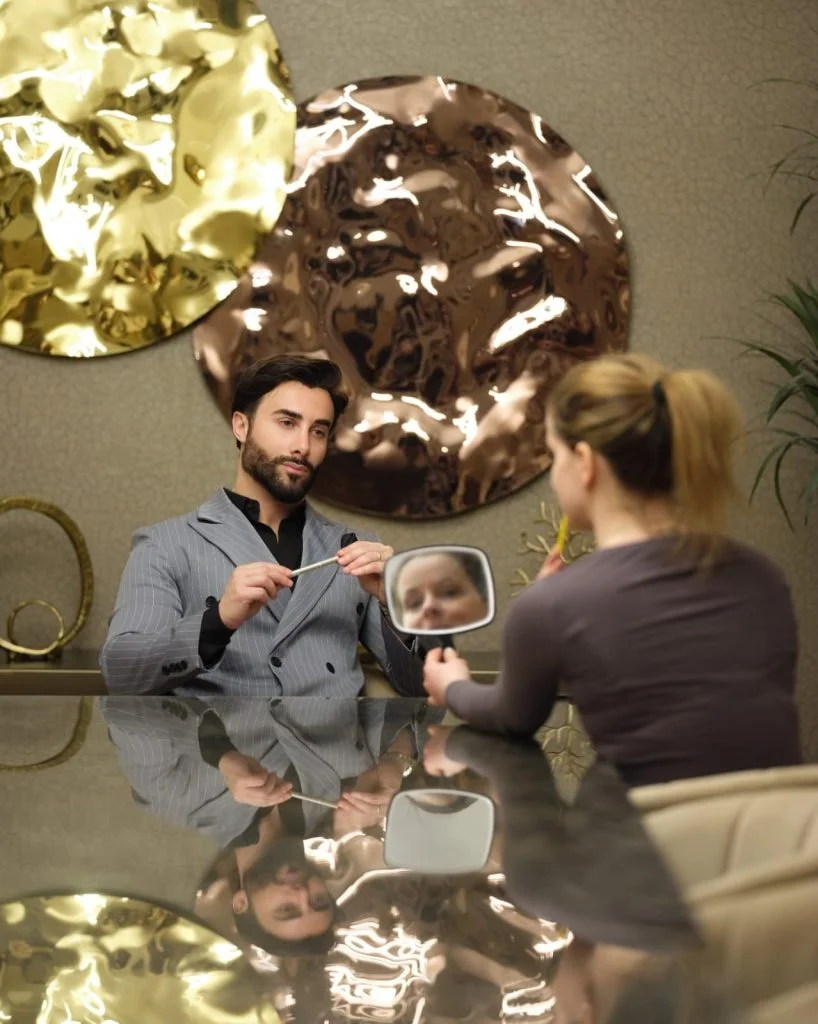
This is why I never start a consultation by asking what someone wants to change. I start by looking at the whole face.
Your face isn't a collection of separate features
Here’s something that sounds simple but changes everything once you really absorb it: your face works as a system.
Every feature exists in relationship to the ones around it. Your nose doesn’t look the way it does in isolation. It looks the way it does in context of your chin, your cheekbones, your forehead. Pull one thing out of balance and the whole system shifts.
Think of it like a room. If a sofa is the wrong size, it’s not always the sofa that’s the problem. Sometimes the issue is that the coffee table is too small and making everything else look bigger than it should.
A weak chin is one of the most common examples I see. Patients come in convinced their nose is too large. But when we map the face properly, the nose is completely normal. It’s the chin that lacks projection and that imbalance is what makes the nose appear dominant. Address the chin and the nose stops being a concern.
That’s proportion. And it’s the most underused principle in aesthetic medicine.
So what actually makes a face look balanced?
There are two frameworks I use every day in practice and I want to walk you through both of them because they genuinely change the way you see faces, including your own.
The Golden Ratio
The Golden Ratio (roughly 1:1.618) is a mathematical relationship that shows up everywhere in nature. In faces, it describes the ideal spacing and sizing between features. Eyes, nose, lips, chin. When these relationships align with the ratio, the face reads as attractive, even if the person looking at it couldn’t tell you why.
What I want to be clear about is that this isn’t a template for making everyone look the same. It’s a diagnostic tool. When I measure a face against Golden Ratio proportions, I’m not trying to create a standard result. I’m trying to identify where the imbalances are so we can address them in a way that still looks entirely like you, just more in harmony with itself.
The Loomis Method
This one comes from fine art, not medicine, which is part of why I love it.
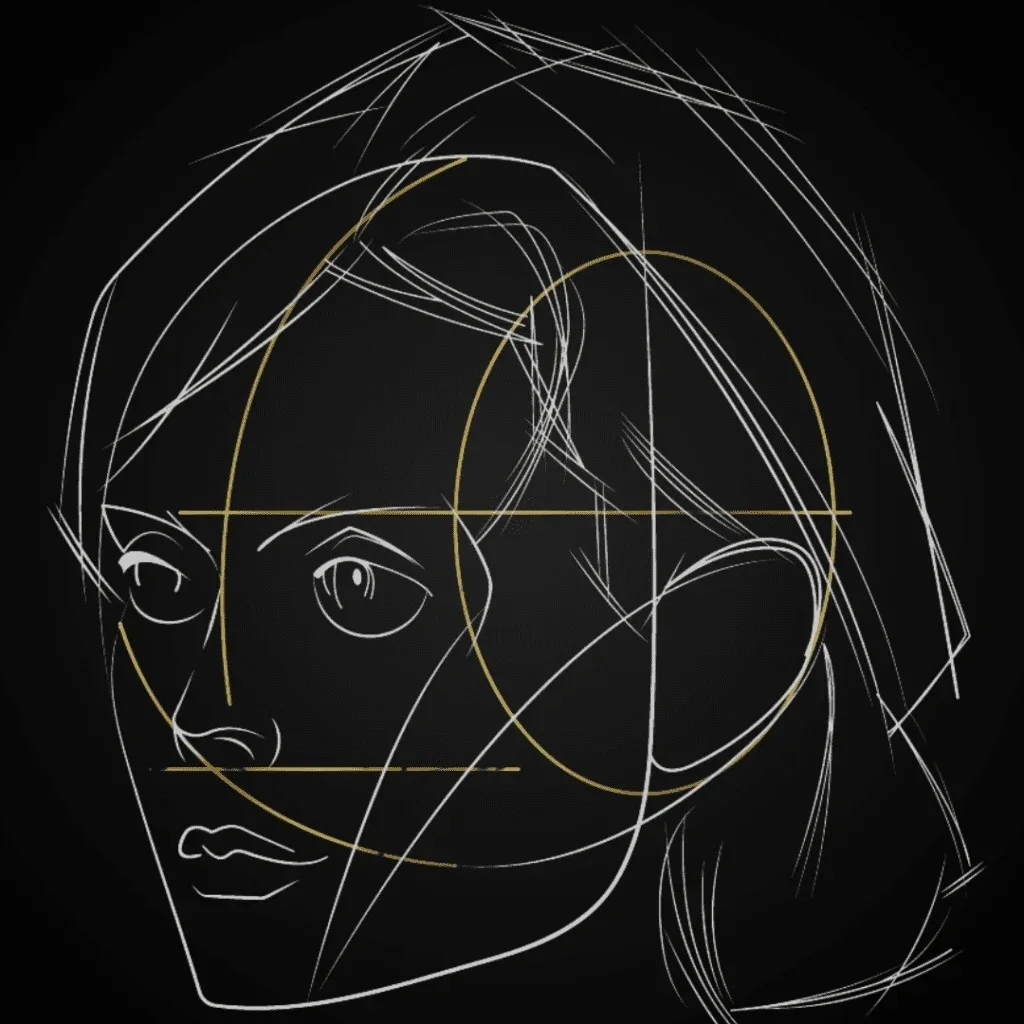
Andrew Loomis was an illustrator who developed a framework for drawing the human face with accurate proportions. He mapped the face into three-dimensional planes and structures, not just a flat set of measurements. I’ve adapted his method for aesthetic practice and it has completely transformed how I approach facial assessment.
Instead of looking at your face like a list of features to tick off, the Loomis Method teaches you to see it as a sculpture. You’re looking at planes that sit forward, planes that recede, angles that lead the eye. And once you see a face that way, it becomes much clearer what it actually needs.
I’ve written a detailed breakdown of how I use this method in practice over here: Understanding the Loomis Method in Aesthetic Medicine
The proportional markers worth knowing about
You don’t need to be a clinician to find these useful. Understanding them helps you see your own face more clearly.
The vertical thirds
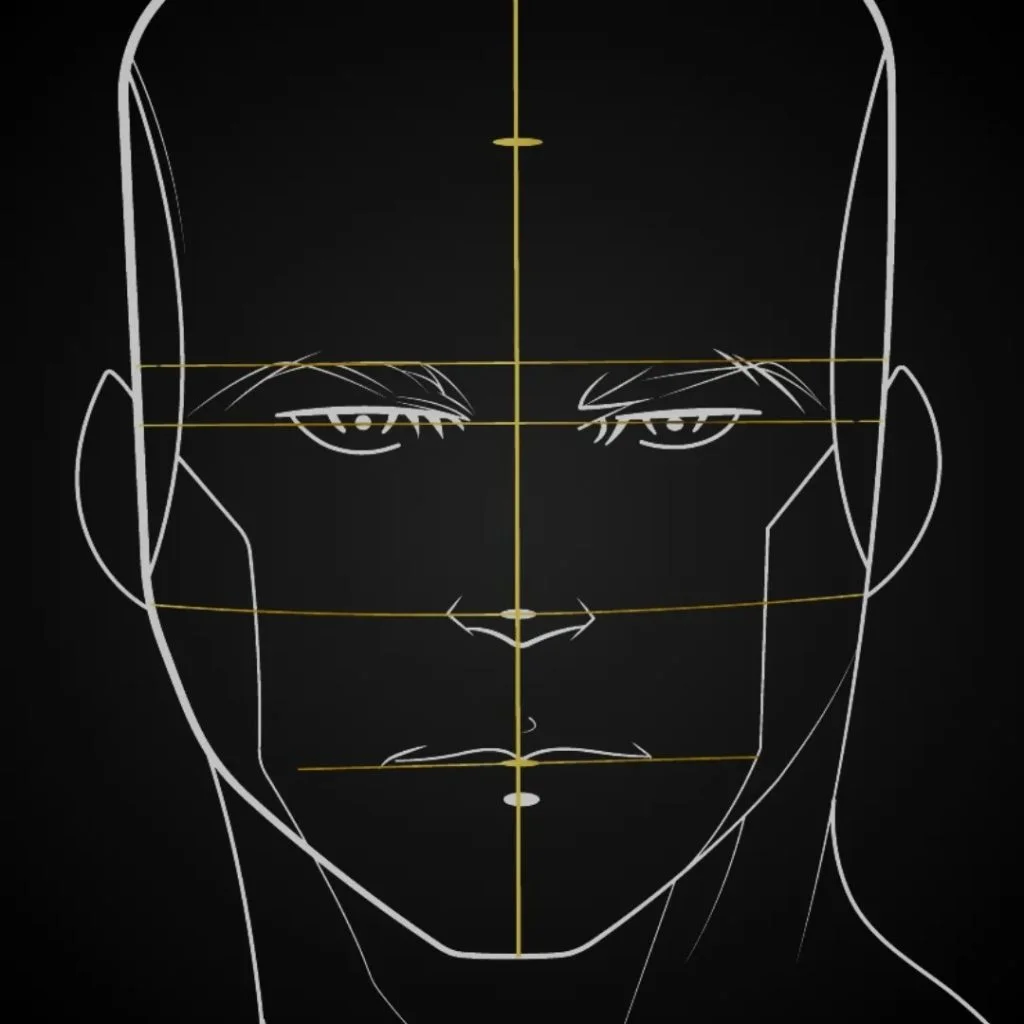
Take your face and divide it into three horizontal bands. From hairline to brows. From brows to the base of the nose. From the base of the nose to the chin. In a balanced face, these thirds are roughly equal. When they’re not, even slightly, it creates an imbalance that registers immediately, even if no one can name what’s off.
The horizontal fifths
Looking straight on, the face can be divided into five vertical sections, each about the width of one eye. The nose sits within the central section. The inner corners of the eyes sit at the boundary of the central fifth. This is where asymmetry between the left and right side of the face becomes most visible.
The side profile and the E-line
This is the one most people have never heard of and it’s one of the most important. The E-line (developed by orthodontist Robert Ricketts) is an imaginary line connecting the tip of your nose to the tip of your chin. Ideally, your lips sit just behind this line. When the chin is weak, the lips appear to fall forward. When the nose projects too far, the same thing happens. Profile harmony is about all three working together.
Chin projection
Honestly, the chin is the most underestimated feature in the entire face. Its forward projection relative to the midface determines whether your lower face looks defined and grounded or whether it falls away and makes everything above it seem heavier. A small improvement to chin projection can make a dramatic difference to how the whole face reads, often more than any other single change.
What happens to facial proportions as you get older
This is something a lot of people don’t realise and it explains a lot.
Ageing doesn’t affect every part of the face equally. Bone volume reduces in some areas more than others. Fat compartments in the midface deflate and drift downwards. The skin follows. These changes don’t happen all at once and they don’t happen symmetrically.
What this means is that the proportional balance you had in your twenties gradually shifts. Features that were once in harmony start to fall out of it. The face doesn’t suddenly look old. It looks less like itself.
This is why the best rejuvenation isn’t about adding volume everywhere. It’s about understanding which proportional relationships have changed and restoring them thoughtfully. Volume in the right place, in the right amount, brings the face back into balance. Volume without that framework just adds bulk.
Can you actually improve facial proportions without surgery?
This comes up in almost every consultation and the honest answer is yes, often very significantly.
The idea that structural change requires surgery is one of the biggest misconceptions in aesthetics. For the vast majority of proportion-related concerns, non-surgical treatment with precisely placed dermal filler, planned against a proper proportional framework, delivers results that are natural, genuinely structural and lasting.
Profile harmonisation is probably the most powerful example. By working on the relationship between the nose, chin and lips with filler, it’s possible to create a dramatically more balanced side profile without surgery, with no downtime and completely reversibly.
The key word in all of this is planned. Filler placed without a proportional framework doesn’t improve balance. It just adds volume. The result can look fine or it can look subtly wrong in a way that’s hard to explain. The difference between those two outcomes is almost entirely in the planning.
Where to start
If any of this is resonating with you, the most useful next step isn’t to pick a treatment. It’s to have a proper facial assessment with someone who actually looks at the face as a whole.
At Sculpt Clinic in Raynes Park, London SW20, every consultation begins with a structured analysis of your facial proportions. We map the Golden Ratio relationships, we apply the Loomis framework and we build a picture of what your face needs before we talk about anything else. If treatment isn’t the right answer, we’ll say so.
If you’re ready to understand your face properly, rather than just fixing one thing at a time, this is where that conversation starts. Book a consultation with Dr Zack Ally in London
Frequently Asked Questions
It means treating the face as a whole system rather than a collection of separate features. The aim is to bring every feature into proportion with the others so the result looks balanced and natural, like the best version of you rather than someone different.
The most common sign is fixating on a feature that feels wrong, but not being able to fully explain why. You might feel like your profile is weak, your face looks uneven, or you look tired even when you’re not. A proper proportional assessment is the clearest way to find out what’s actually going on.
Yes and this is honestly the whole point. Harmonisation is not about changing your appearance. It’s about bringing your features into better balance with each other. The result should feel like a more refined, more balanced version of your own face.
Yes, genuinely. When placed with a clear proportional framework in mind, filler can improve chin projection, restore midface volume and balance the side profile in ways that make a real structural difference. The planning is what makes that possible.
It’s a mathematical proportion (approximately 1:1.618) that describes ideal relationships between facial features. When a face aligns with these ratios, it tends to be perceived as attractive and balanced. In practice, it’s less about achieving a specific look and more about identifying where proportional imbalances exist.
An artistic framework developed by illustrator Andrew Loomis for drawing the human face accurately. Dr Zack Ally has adapted it for aesthetic medicine, using it to map the three-dimensional planes and structures of the face to guide precise, proportion-led treatment planning.
Dr Zack Ally at Sculpt Clinic, Raynes Park, London SW20 specialises in this approach. Every consultation includes a structured facial proportion analysis before any treatment is discussed. You can book through the Sculpt Clinic website.
Most patients find it very manageable. Topical anaesthetic cream is applied before any injections and the whole process is designed to be as comfortable as possible. Any swelling or tenderness afterwards is usually mild and settles within a few days.
Ready to Have an Honest Conversation?
Book a Consultation with Dr Zack Ally
At Sculpt Clinic, consultations begin with listening, not selling. If you have a specific concern you would like to explore with a doctor who will be straight with you, we would like to hear from you. Book your consultation at our London clinic
Book Your Consultation